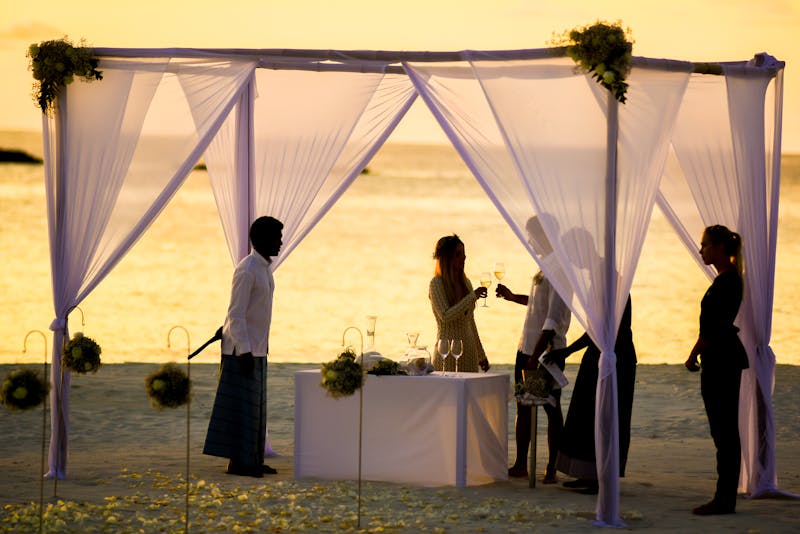
A destination wedding is the ultimate blend of travel and celebration — exchanging vows on a sun-drenched terrace in Tuscany, a clifftop in Santorini, or a beachfront pavilion in Tulum. It is romantic, adventurous, and deeply personal. But asking your loved ones to board a plane, book a hotel, and dedicate several days to your celebration changes the dynamics of your invitation in meaningful ways. Your stationery is no longer just an announcement; it becomes a travel guide, an information packet, and a warm reassurance that the journey will be worth every mile.
In this guide, we cover everything you need to know about destination wedding invitations — from the ideal timeline to the essential details to include, wording examples you can adapt, and creative design ideas that set the tone for an unforgettable trip.
When to Send Destination Wedding Invitations
Timing is the single biggest difference between a domestic wedding invitation and a destination one. Your guests need significantly more lead time to request days off work, book flights, arrange childcare, and budget for travel expenses. The standard domestic timeline simply does not work here.
Save-the-Dates: 10 to 12 Months Before
For a destination wedding, save-the-dates are not optional — they are essential. Send them 10 to 12 months before the wedding date. This gives guests enough time to start planning logistics without committing to an RSVP. Your save-the-date should include the destination, the wedding date, and a note that a formal invitation with travel details will follow. If you have a wedding website set up, include the URL so curious guests can start exploring.
According to Martha Stewart Weddings, sending save-the-dates early is one of the most important things you can do to ensure strong attendance at a destination celebration. The earlier your guests know, the more likely they are to make it work.
Formal Invitations: 3 to 4 Months Before
Follow up with your formal invitations three to four months before the wedding. This is roughly double the lead time of a standard wedding invitation, and for good reason. Your guests will need this time to finalize flights, confirm hotel reservations, and sort out any travel documents. Set your RSVP deadline for six to eight weeks before the wedding so you have time to communicate final headcounts to your venue and vendors abroad.
If you are working within a general invitation timeline, adjust every milestone earlier by about four to six weeks for a destination event.
What to Include in Your Invitation Suite
A destination wedding invitation suite is more comprehensive than a traditional one. Beyond the invitation itself, you are essentially creating a mini travel guide for your guests. Here is what to include:
The Invitation Card
This is the heart of the suite. It should include the couple's names, the date and time of the ceremony, the venue name and its location (city and country), and RSVP information. Keep the design elegant and let the additional enclosure cards handle the logistics.
Travel Information Card
Include the nearest airport and any recommended airlines or routes. If you have negotiated a group rate with an airline, mention it here. Note whether guests will need a passport, visa, or any vaccinations. For international weddings, this card is invaluable and shows your guests that you have thought about their experience.
Accommodation Details
List your recommended hotels or resorts, including any room blocks you have reserved at special rates. Provide the booking deadline, confirmation codes or links, and a range of price points if possible. Guests appreciate having options — a luxury resort for those who want to splurge and a charming boutique hotel for those watching their budget. If the wedding is at an all-inclusive resort, explain what the package covers so guests know what to expect.
Weekend Itinerary Card
Destination weddings often span two to four days with welcome dinners, excursions, rehearsal events, and farewell brunches. A printed itinerary card helps guests plan their time. List each event with the date, time, location, dress code, and any notes (for example, "comfortable shoes recommended for the vineyard tour"). You do not need to account for every hour — leave room for guests to explore on their own — but give them a clear picture of the group activities.
RSVP Card
Include a physical RSVP card with a pre-stamped return envelope, or direct guests to an online RSVP form on your wedding website. Given the international nature of these weddings, online RSVPs are often the most practical option. Ask about dietary restrictions and any travel-related needs (such as shuttle service from the airport).
Wording Examples for Destination Wedding Invitations
The wording on a destination wedding invitation should feel warm, exciting, and informative. Here are several examples you can adapt to your own style and destination:
Classic and Elegant
Together with their families,
Emily Rose Anderson and James Michael Clarke
invite you to celebrate their marriage
on the shores of the Amalfi Coast.
Saturday, the fifteenth of June,
two thousand and twenty-seven
at half past four in the afternoon.
Villa Tre Ville, Positano, Italy.
Reception and dinner to follow.
Please respond by the first of April.
Relaxed and Fun
Pack your bags and join us in paradise!
Sophie and Marco are getting married
in beautiful Playa del Carmen, Mexico.
March 20, 2027 at 5:00 PM
Hacienda del Mar, Riviera Maya.
Cocktails, dinner, and dancing on the beach to follow.
Flip-flops encouraged.
Kindly RSVP by January 15.
Formal With Travel Context
Mr. and Mrs. Robert Chen
request the honour of your presence
at the marriage of their daughter
Lily Wei Chen
to
Daniel Patrick O'Brien,
son of Mr. and Mrs. Thomas O'Brien.
The ceremony will take place at
Château de Vallery, Vallery, France,
on Saturday, the tenth of September,
two thousand and twenty-seven,
at three o'clock in the afternoon.
Dinner reception to follow in the château gardens.
Travel and accommodation details enclosed.
For more wording inspiration across different styles, take a look at our wedding invitation wording guide, which includes templates for every level of formality.
The Importance of Save-the-Dates for Destination Weddings
We touched on timing above, but save-the-dates deserve their own spotlight because they play an outsized role in destination wedding planning. A save-the-date for a local wedding is a courtesy. A save-the-date for a destination wedding is a necessity.
Think of it as the opening chapter of your guests' experience. It is the moment they learn that your wedding will involve travel, and it triggers a cascade of decisions: Can I afford this? Can I get the time off? Do I need a passport? Who will watch the dog? The earlier you plant that seed, the more time your guests have to make arrangements.
Design your save-the-date to reflect the destination. A watercolor illustration of the Santorini caldera, a photograph of the Tuscan countryside, or a tropical palm motif for a Caribbean wedding all work beautifully. Include the destination, date, and your wedding website URL. You can also add a line like "Formal invitation to follow" so guests know more details are on the way.
Passport-Style Invitation Designs
One of the most popular and creative trends in destination wedding stationery is the passport-style invitation. Designed to mimic a real passport, these invitations turn the act of opening your mail into an experience. The cover features the couple's names and a "seal," and the interior pages contain the wedding details, travel information, and RSVP card, each designed to look like passport pages with stamps and visa-style graphics.
Passport invitations work especially well for international weddings. They immediately communicate the travel element and build excitement. You can customize the "stamps" to reflect the destination — think Eiffel Tower stamps for Paris, tropical flowers for Hawaii, or ancient columns for Greece. The format also lends itself naturally to including multiple pages of information without the suite feeling cluttered.
Other destination-inspired design ideas include boarding pass invitations (ideal for a playful tone), luggage tag save-the-dates, and folded map inserts. Whatever design you choose, make sure the essential information remains clear and easy to find. Creativity should enhance readability, not compete with it. For a look at how different printing methods affect the feel of your stationery, see our letterpress vs. digital printing comparison.
Bilingual Invitations: Honoring Two Cultures
Many destination weddings are multicultural, with the couple's families speaking different languages. A bilingual invitation is a beautiful way to honor both cultures and ensure every guest can read and understand the details.
There are several approaches to bilingual invitations. The most common is a two-sided card, with one language on the front and the other on the back. Another option is a gatefold design where each panel features a different language. You can also create two separate invitation suites, each in a different language, and send the appropriate version to each guest.
When designing bilingual invitations, pay attention to text length. Some languages require significantly more space than others. French and Spanish, for example, tend to run about 20 percent longer than English. Work with your designer to ensure both versions have balanced, elegant layouts. Typography matters too — choose fonts that support any special characters or accents required by the second language.
If only a few guests speak a different language, you might include a small translation insert card rather than making the entire suite bilingual. This approach is less costly and keeps the main invitation streamlined. According to Brides, the key is making every guest feel included and informed, regardless of their primary language.
Digital vs. Physical Invitations for Destination Weddings
Given that destination weddings already ask a lot of guests, some couples wonder whether digital invitations might be more practical. The answer depends on your priorities and your crowd.
Physical invitations carry a tactile, luxurious quality that digital ones simply cannot replicate. Holding a beautifully printed passport invitation or a letterpress card with a watercolor map creates anticipation and sets the tone for a memorable trip. For formal destination weddings, a printed suite is almost always the right choice.
Digital invitations, on the other hand, are faster, cheaper, and easier to update if details change. They are also more environmentally friendly and eliminate the risk of international mail delays. For casual destination weddings — think a beach ceremony followed by a barbecue — a well-designed digital invitation can be perfectly appropriate.
A popular middle ground is to send physical save-the-dates (which have fewer details to go out of date) and follow up with a digital invitation that links to a comprehensive wedding website. This gives you the best of both worlds: the excitement of receiving something in the mail and the convenience of having all travel logistics available online, where they can be easily updated.
Extra Tips for a Seamless Experience
Beyond the invitation itself, here are a few additional considerations that will make the process smoother for both you and your guests:
- Create a detailed wedding website: Your invitation suite can only hold so much. A wedding website is the ideal place for maps, detailed driving directions, local restaurant recommendations, packing tips, weather forecasts, and answers to frequently asked questions. Platforms like Zola make it easy to build a polished site in an afternoon.
- Consider welcome bags: A small welcome bag at the hotel — with a printed itinerary, local snacks, sunscreen, or a small bottle of wine — extends the invitation experience beyond the paper and makes guests feel truly cared for upon arrival.
- Be mindful of costs: Your invitation should gently acknowledge that you are asking guests to invest time and money. A line like "Your presence is the greatest gift" signals that you do not expect lavish wedding presents on top of travel expenses.
- Plan for non-travelers: Some guests will not be able to make the trip. Consider hosting a casual celebration at home after the wedding for those who could not attend. Mention this possibility on your wedding website so no one feels excluded.
Bringing It All Together
A destination wedding invitation is so much more than a piece of paper. It is the first impression of your entire wedding experience — the moment your guests begin to picture themselves celebrating with you in a beautiful, faraway place. By sending your communications early, including every piece of information your guests need, choosing wording that balances warmth with clarity, and selecting a design that captures the spirit of your destination, you create an invitation suite that builds genuine excitement and makes the journey feel effortless.
Take the time to get it right. Your guests are giving you the incredible gift of their time and presence in a place far from home. A thoughtful, well-crafted invitation tells them that every detail of their experience matters to you, from the moment they open the envelope to the moment they step onto the dance floor under a canopy of stars.